
Weekly digest #81
day 0 is loud. day 2 is real., Just follow the talent, 9-9-6-0


We (Matt and Shray) read hundreds of articles on company building, venture investing, and self-management and curate the best ones into a weekly digest to help founders and operators stay on the top of their game.

Better thinking
The State of OnlyFans in 2025 (10 minute read)
Bet you weren’t expecting that. Damage to dopamine receptors aside, OF has produced a pretty incredible business. It’s probably the most holistically successful UK start-up since DeepMind in 2010, media platform since TikTok in 2014, and creator platform ever. That said, revenue growth is now slowing substantially (9% YoY versus 19% in 2023) and operating profit is growing slower still (3% versus 22%). Maybe this is a good thing?
What got lost in the optimization (6 minute read)
Everything got optimised for what’s measurable. Engagement, clicks, time on site. The problem is that unmeasured things like meaning and depth get sacrificed along the way. AI will accelerate this pattern in one direction or another. The difference between hollow and meaningful experiences is whether they leave you nourished or depleted.
Day 0 is loud. day 2 is real. (4 minute read)
In the age of AI, anyone can conjure a day 0. The models can write your story, design your logo, fake your trailer, and inflate your ego. Day 2, though, doesn’t care who your investors are, how ugly your competitor’s brand is, or how many likes your launch thread got. Day 2 asks one question, over and over, in silence: did this thing actually make someone’s life easier to live? If the answer keeps being ‘yes’, you don’t need to scream. If the answer keeps being ‘no,’ you can ship a hundred more features and it won’t matter. Day 0 is theater. Day 2 is truth. Build for the second day. Everything else is decor.
Operational tactics
Building in public is scary. Do it anyway. (5 minute read)
I thought we’d already had this debate. For most companies, treating a launch like a Hollywood premier is ngmi. Instead, build in public with short and frequent updates. Users see constant improvements, feel like they’re getting free upgrades, and start rooting for you. Yeah, it’s scary and messy. But in the AI era, things move too fast for polished campaigns anyway. Building in public builds trust.
Why your marketing isn’t working (8 minute read)
Most marketing fails for two reasons. Either you have great content but no way to distribute it, or you fall into random acts of marketing where you copy tactics from other companies without a clear strategy. The fix is to spend most of your time on what’s working. If you’re just starting out, that means testing until you find it. The article also has a few other sections on M&A and AI, they were less interesting.
Becoming great at listening (1 minute read)
Listening and thinking don’t pair well together. Your job as a listener is to consume in a few seconds or minutes what the speaker probably experienced over weeks, months, even decades in some cases. When listening, just listen. Don’t judge, don’t filter, don’t be overcome by emotions. Once listening is over, pause. Take a deep breathe. Then switch into thinking mode; evaluate and synthesize what’s been shared with your own experience and viewpoints. The silence can be awkward for some but the degree to which you would have absorbed the speaker’s message will be reflected in the quality of your response. This post also has a 15 minute deep-dive explaining why gaining mastery in listening isn’t a feel-good, altruistic act, rather, it is the most practical thing you can do towards becoming a world-class leader.
Refer and we’ll send you our favorite books as a “thank you” for spreading the word.
Venture investing
Just follow the talent (2 minute read)
The Solow Growth Model helps explain whether an economy is growing because it’s adding more inputs (capital or labor) or because it’s using those inputs more efficiently. While the model was designed to evaluate economics, it applies well to companies, especially early-stage ones. The major takeaway with loose but entirely defensible ties to math, statistics, and economics, is that the thing that matters most - arguably the only thing that matters - is talent density. Everything else is downstream of getting the people right. If you’re interested in the math and examined macro productivity statistics from 1987 - 1995, go on and read this piece.
Startup diligence guide: The D+ financial model (9 minute read)
This guide is designed for pre-seed and seed-stage founders, though the framework applies to later-stage companies as well. Founders and venture investors often dismiss the need for a financial model for a pre-seed or seed round. But a D+ model is something you can pull together in 60 minutes that captures the key top-level points about hiring pace, key cash expenditure, revenue inflow, cash balance, and number of months of runway. The exercise is less about precision and more about clarity. It’s about showing that you understand your levers, can manage capital efficiently, and can tell a believable financial story for the next 12-18 months. To get you started, here’s a P&L template that’ll help you prepare to answer common questions that many investors ask.
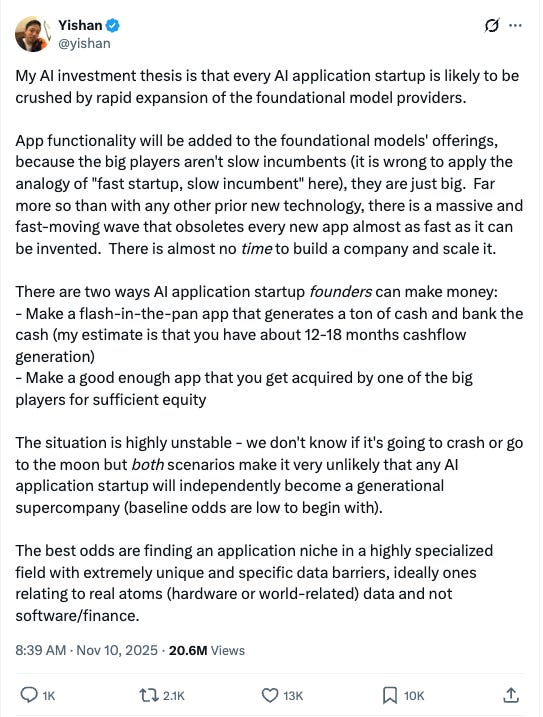
AI investment strategy (2 minute read)
Career management
The junior hiring crisis (7 minute read)
The traditional apprentice model in technology has been slowly eroding and AI is accelerating that. Yes, companies’ incentive models are not in favor of the employee. And yes, the 10-20 year talent pipeline is at risk. If you’re a student or early-career professional, start building that relational intelligence now. Identify about 10-20 key relationships and get intentional with them. If you’re a senior engineer or manager, teaching forces clarity. When you have to explain things in their most basic form, you understand it more deeply, and this, in turn, benefits the entire team. Relationship skills have always been a differentiator, but now they’re a necessity.
21 Lessons from 14 Years at Google (8 minute read)
Addy Osmani joined Google 14 years ago and he thought the job was all about writing great code. He was partly right but the longer he stayed, the more he realized that the engineers who thrive aren’t necessarily the best programmers but rather the ones who’ve figured out how to navigate everything around the code: the people, the politics, the alignment, the ambiguity. While 21 lessons sounds like a lot, it really boils down to a few core ideas: stay curious, stay humble, and remember that the work is always about people: the users you’re building for and the teammates you’re building with. If you’re early in your journey, know that it gets richer with time. If you’re deep into it, some of these lessons will resonate. Consider this Addy’s attempt to pay it forward.
There’s a lot of lore about 996 in the AI era. Work from 9 am to 9 pm, six days a week. Seventy-two hours a week; 3,600 hours a year; 10,000 hours in three years. Sometimes working 996 adds up to generational wealth. Sometimes, it adds up to 0. If you work in tech, you know an entire rolodex of people, grinding hard, for the long term. You might want the best for some of them; some of them might be your friends. For many of them, it won’t work out. This part, their disappointment, yours, or somebody’s, is inevitable. Though it can’t be stopped, and their time cannot returned, that doesn’t mean nothing can be done. Because in the very long term, the memories matter more than success. So pay attention. Watch your friends work; see what they’re sacrificing. Call them, email them, and wish them a happy birthday. See, and show them what you see. Because when this bubble bursts, and people’s work gets erased and their hours wasted, all that remains is what other people witnessed. And it is on each of us to remember what they hope we do not forget.
Love this!