
Weekly digest #89
Someday we will all be artists, Dreams of stability, It took me 30 years to learn what I’ll tell you in 13 mins


We (Matt and Shray) read hundreds of articles on company building, venture investing, and self-management and curate the best ones into a weekly digest to help founders and operators stay on the top of their game.

Better thinking
Someday we will all be artists (9 minute read)
As human labor becomes increasingly automated, there will come a day when most if not all of us will end up doing work that could be classified as art, or at least artisan. This means an increasing share of demand for commodity production (of tasks where the identity of the producer is irrelevant to the consumer) will naturally shift towards goods and services where human identity, story, and craft matter. We’ve been here before with the camera. As the camera automated the mechanical dimension of capturing reality, it didn’t eliminate the practice. It transformed it dramatically and forced practitioners to develop the dimensions of their work that the machine cannot replicate like self-expression.
Dreams of stability (12 minute read)
“What do you do?” Everyone hates this question because the answer’s never about what you actually do. It’s about what people think you’re worth, and what you want people to think you’re worth. A few years ago, risky career bets were glamorous but now, ambition is reorienting itself from limitless ascension to find solid ground first. Stability has become the new status. Every hedger and gambler is seeking stability as the concept of an ‘enduring career’ is eroding. With limited stability to be found in any credential, company, or career ladder, we must find it in ourselves, our craft, and our people.
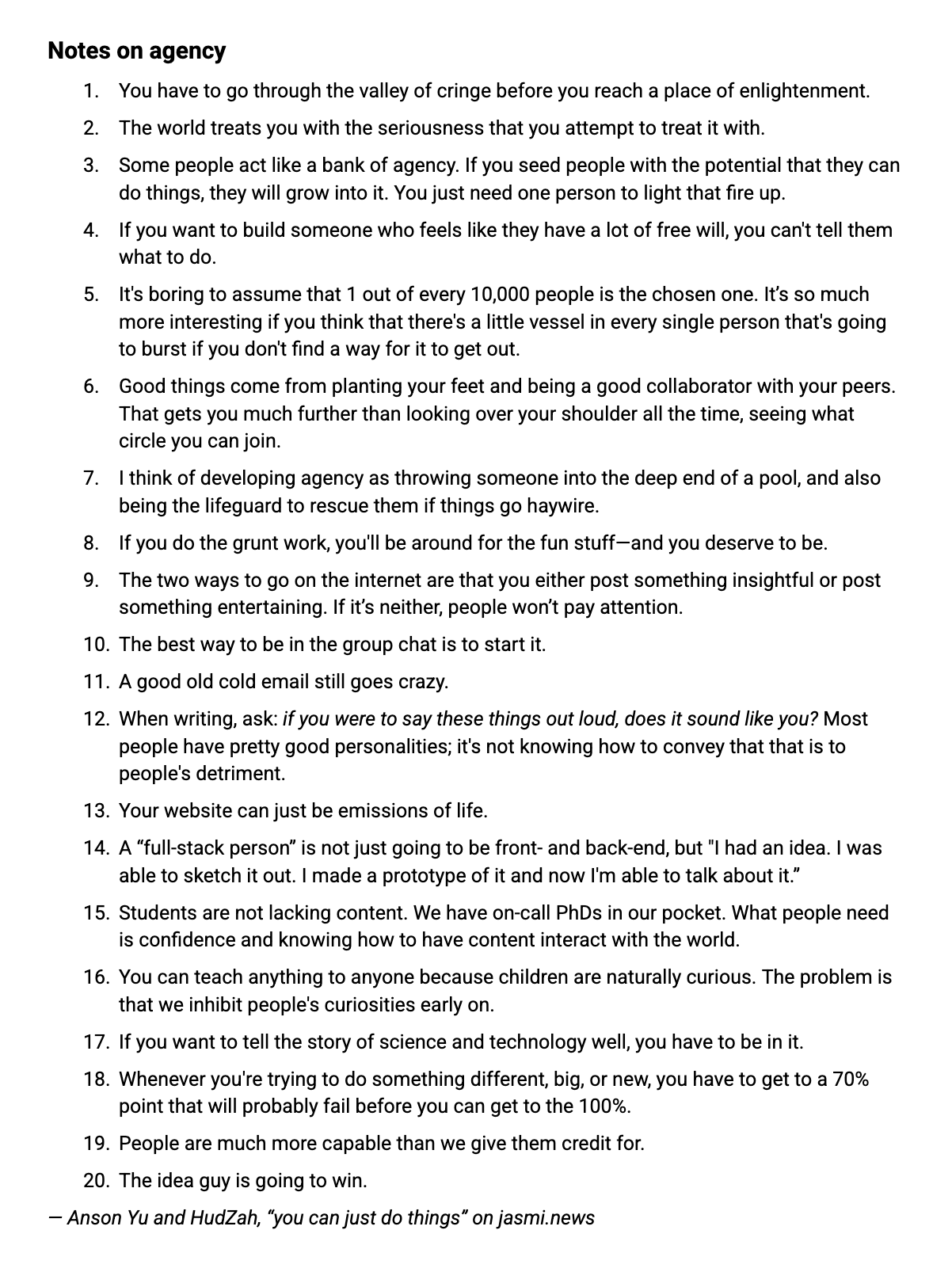
Notes on agency (2 minute read)
Operational tactics
Your org structure is my opportunity (2 minute read)
Some roles used to make sense. The PM had the idea and the engineer helped to build it. The separation existed because it was difficult to do the next step yourself but AI’s blown that thesis apart and it’s time to redraw the org chart. Startups should hire for tinkerers or full-stack builders; people who can talk to customers, build the fix by noon, and ship the release. Companies with roles for every function inherently have gaps between them. Those gaps add up to weeks, and in those weeks your customers are already talking to someone who doesn’t work that way.
About that Matt Shumer post that has nearly 50 million views (3 minute read)
Last week, Matt Shumer’s post titled ‘Something Big is Happening’ went mega-viral. It’s a masterpiece of AI hype, written in the style of the old direct marketing campaigns. But his post stumbles on the facts and provides no credible evidence to support his claims that the latest coding systems can write whole complex apps without errors. Even if they can, AI-generated code is quickly becoming an enormous security risk as teams struggle with the underlying models’ illusions of correctness. It should also be noted in the record that Shumer’s notoriety is well-documented. In the past, he exaggerated claims about releasing a big model that didn’t replicate and many people saw this as fraud.
Many smart people are poor communicators. They ramble and frequently get lost in their own train of thought. By conventional standards, they come across as ‘unintelligent’. However, judging people’s competence by their ability to quickly respond well to questions or ideas is a subjective bias. Many smart people ‘externally process’ information and may need to talk out their thoughts before presenting a final answer. But even after external processing, people can be ineffective at expressing themselves because they feel uncomfortable or under pressure. Instead, care less about someone’s ‘latency’ and give them time and space to drive the conversation. Even if that means extra time to externally process and stumble over their words.
Refer and we’ll send you our favorite books as a “thank you” for spreading the word.
Private investing
Anthropic could surpass OpenAI in annualized revenue by mid-2026 (1 minute read)
The headline says it all. OpenAI may be a household name, but Anthropic could soon be earning more revenue. Since each company hit $1B in annualized revenues, Anthropic has grown substantially faster (10× vs 3.4× per year) and could overtake OpenAI by mid-2026 if recent trends continue. Extrapolating recent trends is an aggressive way to forecast revenues. Still, a crossover is likely to happen in 2026 or 2027. Dive deeper into the dataset here.
The next big thing in 2026 will be... (17 minute read)
Nikhil Basu Trivedi, co-founder and GP at Footwork, shortlists predictions for the year ahead based on his back-and-forth pings with founders of companies like Applied Intuition, Instacart, and NVIDIA, leaders at companies including Canva and OpenAI, and venture capitalists at firms such as a16z, Emergence, and USV.
The cost of staying (6 minute read)
Every technical person is deliberating their options and wondering how much it’s costing them to stay put, not in dollars, but in time. The valuable skill in tech went from execution to judgment and those who figured it out early are on the arm of a widening K-curve. The trade-offs are unique depending on your environment. If you’re at FAANG, you’re increasingly reviewing AI-generated output rather than building from scratch. The ones staying are betting that stability and compensation are worth more than being close to the frontier. But the math is directional: the longer you optimize for comfort, the more expensive the switch becomes because the people at the frontier are compounding while you’re still waiting to act. Put away the calculator and consider taking action before it’s too late.
Career management
While everyone’s stuck debating whether AI will take their job or not, this discourse is no longer interesting. The more important question is this: what if this is the biggest opportunity of your career? A motivated individual with curiosity and initiative can now do what used to require a team. Early adopters are compounding advantages by learning faster, shipping faster, and building confidence faster. At this very moment, curiosity beats credentials. So stop doom-scrolling and open Claude, ChatGPT, Cursor, or Lovable. Lock in and vibe-code an app, website, or small project that you’ve been meaning to work on. For goodness’ sake, just start already.
How to work with anyone (6 minute read)
As your career progresses, technical excellence becomes table stakes. Strategy matters, and vision matters, but the ability to work with almost anyone quietly becomes one of the most decisive skills you can develop. You will not always get to choose your team, and you will not always get to change the context. But you can choose how you show up. You can choose curiosity over criticism, alignment over assumption, and generosity over scarcity. Most people are not your enemy. They are navigating their own constraints, ambitions, and fears, just like you are. When you learn to see that clearly, you unlock a level of leadership that no title can give you.
It took me 30 years to learn what I’ll tell you in 13 mins (13 minute watch)
Chamath being Chamath. He’s started a new YouTube channel and his first drop’s about the most important lessons he’s learned over three decades. It’s a short watch so take away what you can. The rumor on the street is he’s entering his Naval era, and we all know what that means. If you become a subscriber, expect weekly drops on Friday’s.